What’s so special about Cartier?
Discover the Cartier history timeline and what makes Cartier special through the stories behind Love, Trinity, Panthère, Juste un Clou, Santos and Tank.


Discover the Cartier history timeline and what makes Cartier special through the stories behind Love, Trinity, Panthère, Juste un Clou, Santos and Tank.


A bracelet fastened with a screwdriver. A ring made from three bands of gold. A watch inspired by a military tank. Cartier has repeatedly turned remarkably simple ideas into some of the most iconic jewellery pieces and watches in the world. Best known for watchmaking and jewellery, Cartier is driven by Louis-Francois’s motto: “Never imitate, always innovate”.
That, in our opinion, is what is so special about Cartier. Its reputation does not rest on one successful design or a famous red box. The Cartier brand has created a visual language strong enough that many of its pieces can be recognised from their outline alone.
What is Cartier? Cartier is a French luxury jewellery and watchmaking house founded by Louis-François Cartier in Paris in 1847. Although the Cartier origin story is firmly French, the house soon attracted an international clientele. Its reputation grew further in 1904, when King Edward VII granted Cartier a royal warrant and described it as “the jeweller of kings and the king of jewellers”. The Cartier full name is simply Cartier, inherited from its founder’s family name.
In 1917, Pierre Cartier acquired the mansion that became Cartier’s Fifth Avenue flagship in exchange for a double-strand natural pearl necklace, reportedly valued at $1 million at the time. Today, Cartier is part of the Swiss luxury group Richemont, but the house retains its own identity, design studios, workshops and heritage.
If we had to choose one design that explains what Cartier is famous for, it would be the panther. LOVE may be the most instantly recognisable bracelet, but Panthère represents the house at its most imaginative: glamorous, technically ambitious and slightly dangerous.
The Panthère not only ranks as one of Cartier’s most iconic collections but it stands out across the world of luxury jewellery. The panther emerged in 1914, when its spotted motif appeared on a watch. Jeanne Toussaint, appointed director of Cartier’s fine jewellery department in 1933, later developed it into the sculptural, three-dimensional animal now closely associated with the house.
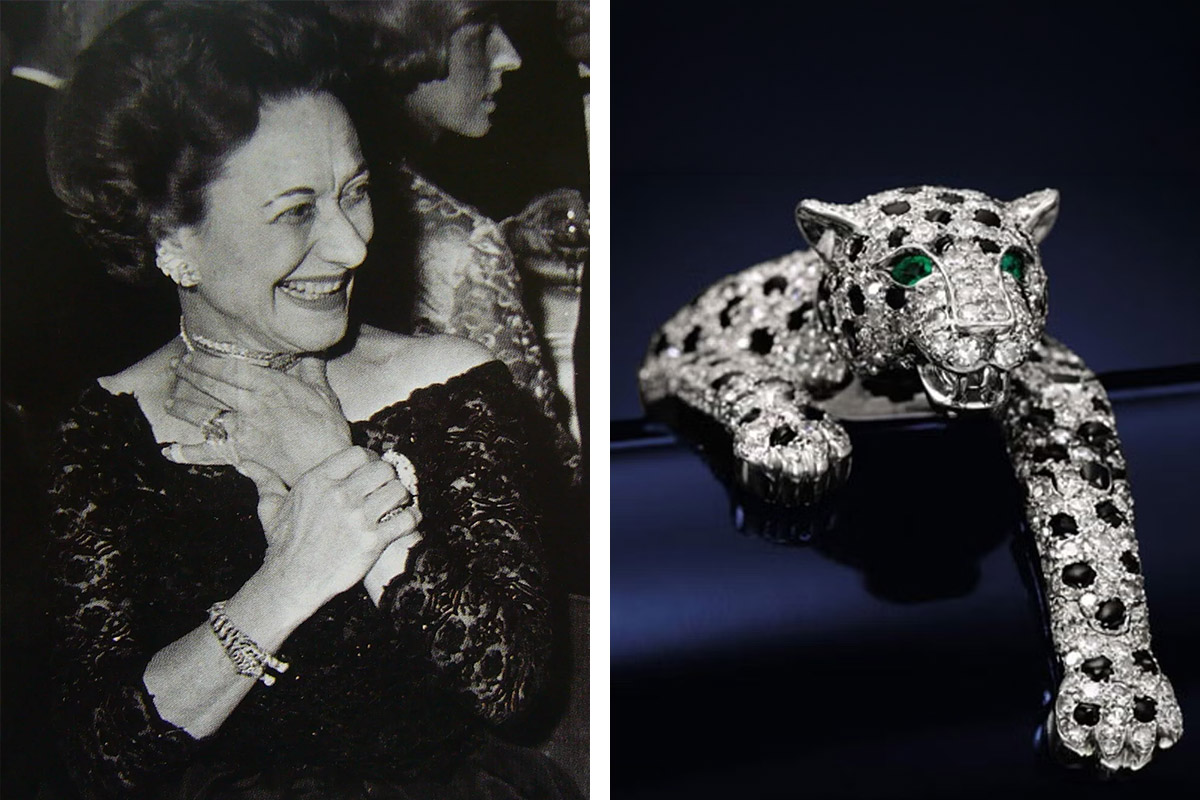
Panthère de Cartier is also associated with celebrities and royalty. One of the best-known examples was created for Wallis Simpson, the Duchess of Windsor. Her 1948 gold, enamel and emerald Panthère brooch helped establish the naturalistic style still associated with Cartier. In 2010, her onyx and diamond Panthère bracelet sold for more than £4.5 million.
The Cartier LOVE bracelet changed the way fine jewellery could be worn. Aldo Cipullo designed it in New York in 1969 as a close-fitting, unisex bracelet secured with a small screwdriver.
The fastening made the design memorable. Its screw motif is decorative, but it also represents commitment: the bracelet is meant to be secured rather than slipped casually on and off. LOVE now includes rings, necklaces and earrings, alongside bracelets in yellow, rose and white gold and diamond-set variations. Its strength is the contrast at the centre of the design.
Famous couples associated with the Cartier LOVE bracelet include Elizabeth Taylor and Richard Burton, Steve McQueen and Ali MacGraw, and Sophia Loren and Carlo Ponti. In our opinion, it is not the romance alone that makes Cartier LOVE so special. Cipullo made an industrial detail, the screw, feel intimate.
Introduced by Louis Cartier in 1924, Trinity de Cartier is one of the house’s oldest collections still in production today. What does the Cartier Trinity ring mean? Trinity is formed from three interlocking bands of yellow, white and rose gold. The colours are traditionally associated with fidelity, friendship and love.
The design became closely linked with French artist, poet and filmmaker Jean Cocteau, who wore stacked Trinity rings on his finger. The collection has since expanded to include bracelets, necklaces and earrings, but the original ring remains the clearest expression of the idea.
Trinity is perhaps the quietest of Cartier's iconic jewellery designs. There is no obvious logo. Its identity comes entirely from the construction, which is why the ring remains recognisable without needing to announce who made it.
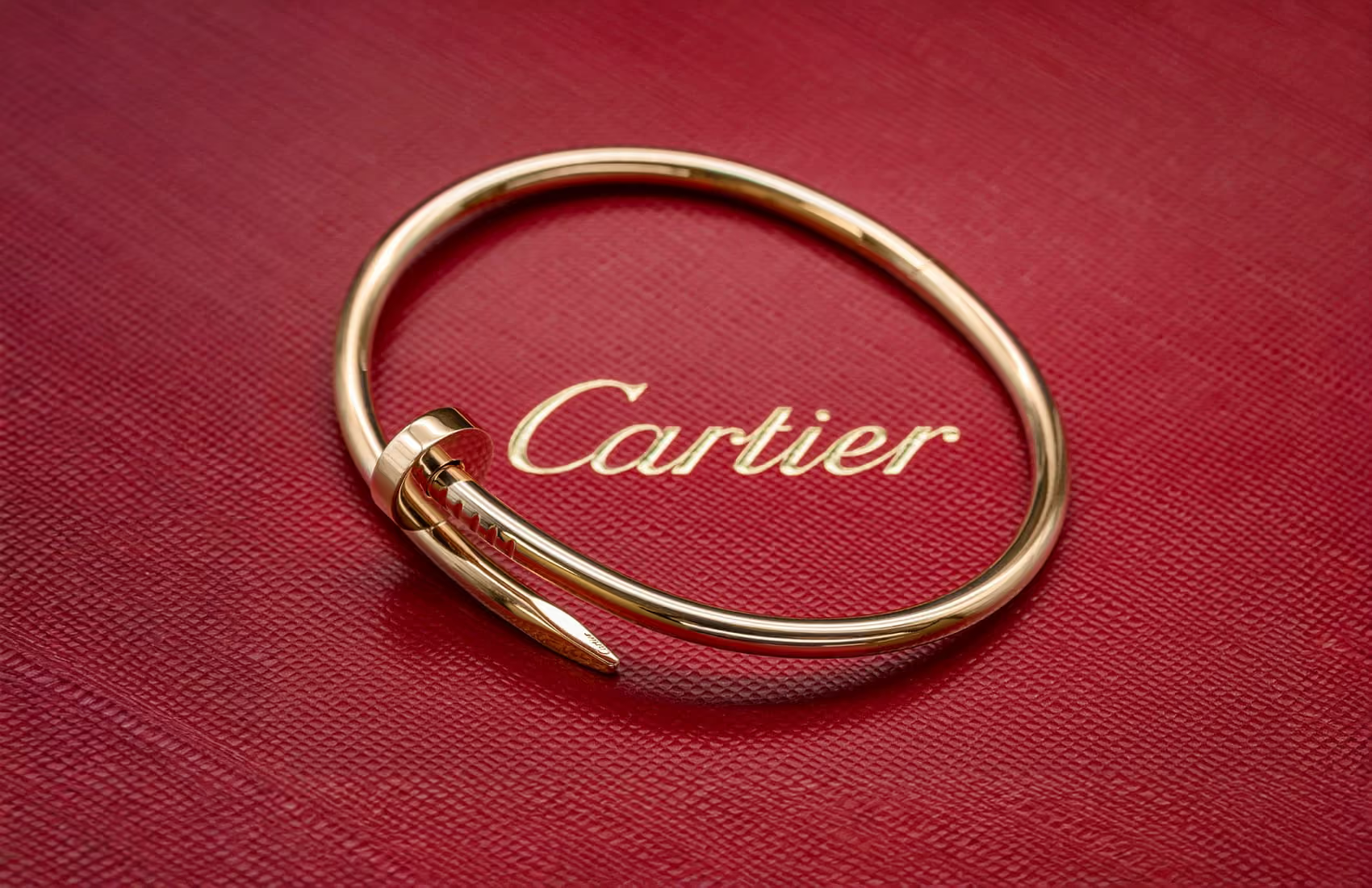
Aldo Cipullo designed the original nail bracelet in New York in 1971. He used an everyday nail, which he bent around the wearer’s wrist. The design was inspired by New York’s wild spirit and freedom in the 1970s but the piece was to be constantly wearable. Cartier relaunched it as Juste un Clou - ‘just a nail’ - in 2012 and developed the idea across bracelets, rings, earrings, necklaces and cufflinks.
The concept is deliberately simple: an everyday nail curved around the body. Its head, point and clean line are not hidden or softened. That directness is precisely what makes it work. Juste un Clou proves that Cartier can turn an ordinary object into fine jewellery without losing the wit of the original idea.
The Santos began with a practical problem. In 1904, Brazilian aviator Alberto Santos-Dumont told his friend Louis Cartier that checking a pocket watch while flying was difficult. Cartier created a flat wristwatch that could be read while the pilot kept his hands on the aircraft's controls. The design was offered commercially in 1911.
Its square bezel, visible screws and geometric case still look distinctive. The Santos is often described as one of the earliest purpose-designed men's wristwatches and an important step in moving the wristwatch beyond women's jewellery. The Santos shows what Cartier does particularly well in watchmaking: it gives a practical object a clear visual identity. The construction is not disguised. The screws and case architecture are central to the design.
Louis Cartier designed the Tank in 1917, taking inspiration from the shape of military tanks viewed from above. Its two vertical brancards echo the tracks, with the rectangular dial positioned between them. The watch entered wider production in 1919.
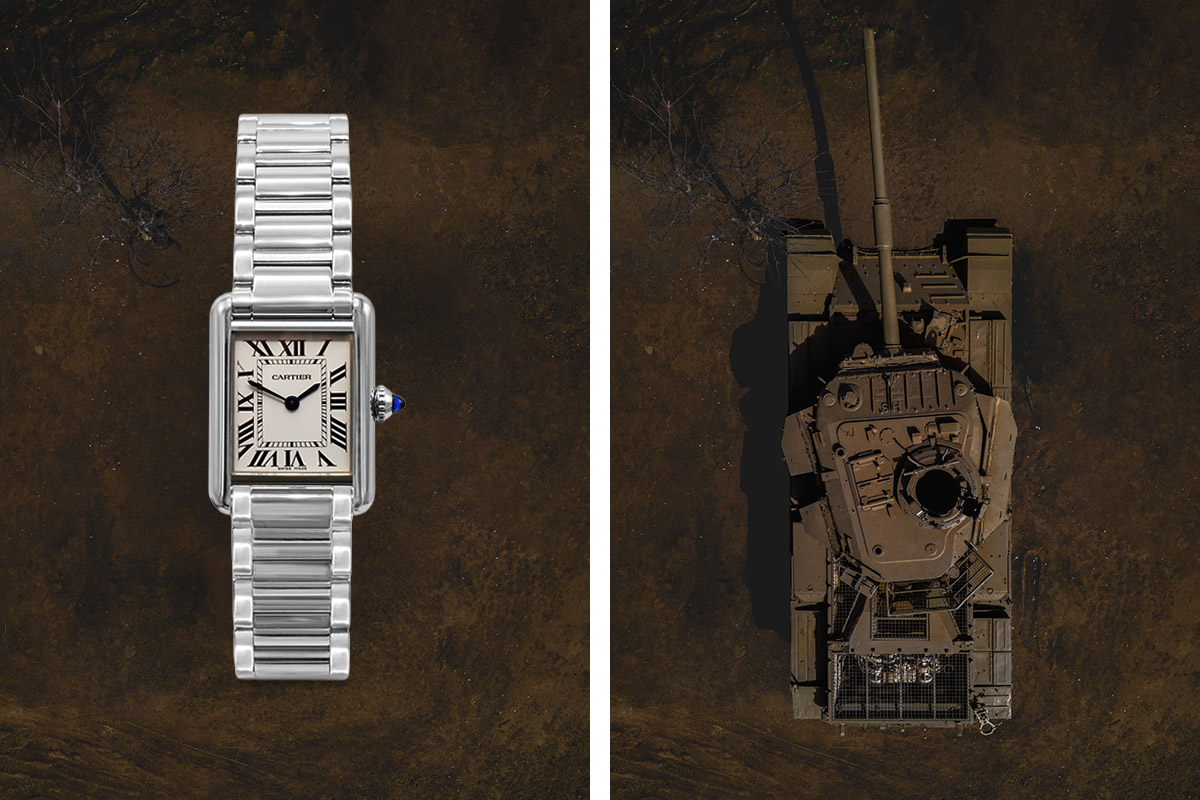
The origin may be severe, but the finished design is balanced and elegant. Roman numerals, a railway minute track, blued hands and a cabochon-set crown soften its strong geometry. For us, the Tank is Cartier's strongest watch design. Its proportions and details have evolved, but its identity has remained intact for more than a century. Few watches are as easy to recognise from their outline alone.
The Tank has been worn by figures including Jacqueline Kennedy Onassis, Andy Warhol, Princess Diana and Michelle Obama. Diana owned both a gold Tank Louis Cartier and a Tank Française; the latter later passed to the Duchess of Sussex.
Cartier’s Tutti Frutti jewellery was influenced by Jacques Cartier’s travels through India. The designs combined carved emeralds, rubies and sapphires with diamonds in colourful Art Deco settings. Created mainly during the 1920s and 1930s, these pieces were originally known as pierres de couleur or “Hindou jewels”. The name Tutti Frutti was not widely used until the 1970s.
Many of Cartier’s most memorable creations began with a client’s personal vision. In 1966, Mexican film star María Félix commissioned a fully articulated serpent necklace set with almost 2,500 diamonds. The life-sized piece took Cartier around two years to complete. Gloria Swanson also brought Cartier into cinema history when she wore her own diamond and rock-crystal bracelets in Sunset Boulevard, nearly 20 years after buying them.

Elizabeth Taylor’s connection with Cartier produced another remarkable story. In 1969, Cartier bought a 69.42-carat pear-shaped diamond at auction for $1.05 million. Richard Burton acquired it shortly afterwards and gave it to Taylor, leading it to become known as the Taylor-Burton Diamond. Taylor sold the stone in 1979 and used part of the proceeds to help fund a hospital in Botswana.
Why Cartier? The obvious answers are precious materials, skilled workmanship, heritage and scarcity. But those qualities are shared by many luxury houses. Cartier's greater advantage is that it has several distinct design codes rather than one bestseller carrying the entire brand.
That recognisability also supports resale value demand for Cartier jewellery and watches, although not every Cartier piece will rise in value. Condition, reference, age, rarity, materials, provenance and market demand all matter.
Our conclusion is simple: Cartier is famous because it designs symbols, not merely products. A screw, a nail, three bands, a panther or a rectangle can communicate the house before its name is visible. That is the difference between a popular piece and a lasting icon.
{{resource-cta="/dev/components"}}
Founded in 1847, Cartier is 179 years old in 2026.
Cartier is known for far more than classic Cartier jewellery and watches. Its history includes tiaras, handbags, accessories, writing instruments, decorative objects and mystery clocks with hands that appeared to float.
Cartier watches are made in Switzerland, with much of its watchmaking centred at the company’s manufacture in La Chaux-de-Fonds.
Cartier’s high prices reflect its precious materials, specialist craftsmanship, distinctive designs and long-established reputation and many other reasons making Cartier special. Demand for recognisable collections such as LOVE, Panthère, Santos and Tank also contributes to their Cartier jewellery value and Cartier watch value.
Cartier does not have one single ambassador. It works with several ambassadors and friends of the Maison, including JISOO, who represents Panthère de Cartier.
Tiffany is best known for diamonds and classic American jewellery, while Cartier is recognised for French design, iconic collections and watchmaking. Neither is universally better; the right choice depends on the piece and your personal style.
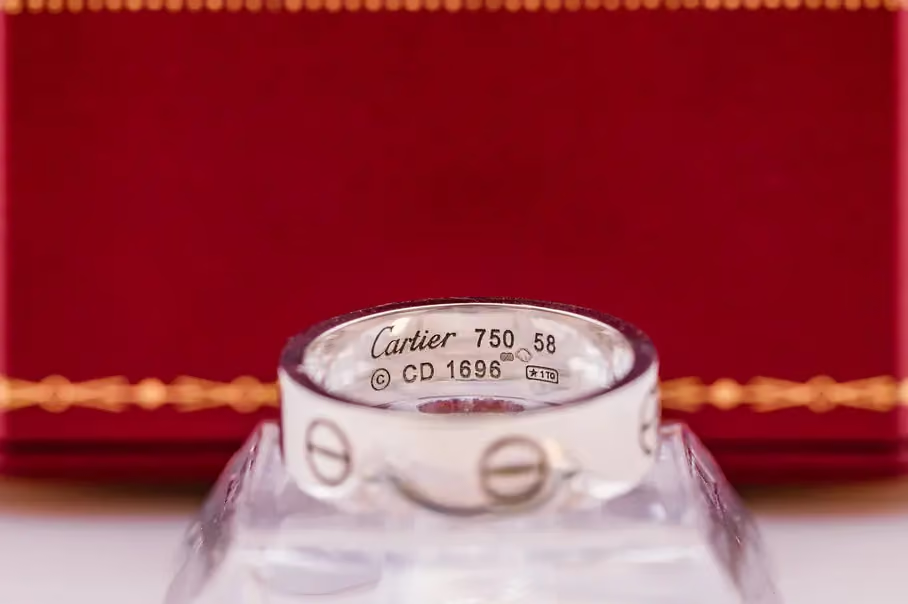
Check the piece’s proportions, finishing, hallmarks, serial number and overall quality, but do not rely on one detail alone. Professional authentication is the safest way to confirm whether a Cartier piece is genuine. Find out more on how to tell real Cartier LOVE jewellery and how to tell real Cartier watches.
Rolex is generally associated with robust sports watches and traditional watchmaking, while Cartier is particularly strong in distinctive design and jewellery-inspired watches. The better choice depends on the style and qualities you value most. Find out more in our Cartier vs Rolex comparison.
Cartier is French. It was founded in Paris in 1847 by Louis-François Cartier.
If you are looking to buy preloved Cartier jewellery or watches, shop our collection of pre-owned Cartier jewellery and Cartier watches.
If you own a Cartier piece and would like to unlock its value, explore your options for selling Cartier jewellery, selling a Cartier watch or arranging a loan against Cartier with us today.